 FR
 EN
 ES
 IT

HOW TO REMOVE STAINS ON A LEATHER SOFA?
Is the leather on your sofa deeply stained?
Is your leather sofa stained with baby milk, or by a series of little accidents, and you don't know how to remove these stains? Have you tried to clean it as best you could but nothing works and the stains are still there? Worse still, have they become ingrained?
Don't panic: at Sofolk, we offer two solutions and a professional result. The first is to clean the sofa with our powerful Degreasing Stain Remover Cleaner. And if this solution doesn't work, you will be able to hide the stains with our paint for leather and leatherette.

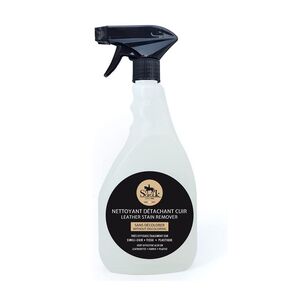
Sofolk Degreasing Leather Stain Remover Cleaner
The first solution is to use this product to remove stains from the leather sofa.
It has been specially formulated for cleaning leathers (sofas, armchairs, car seats), but it is also very effective on alcantara (composite fabric) and other fabrics such as microfibre and Skaï (a trademark registered by a German manufacturer).
The Sofolk Stain Remover Cleaner removes stains and deeply degreases the leather of your sofa without any discolouration. This product can also be used on a Club armchair or a leather car seat...
This product can also be used to treat sebum rings, usually visible where the head rests on sofas.
Spray and wait up to 2 minutes for the product to work. Wipe everything off with a microfibre cloth. Do not hesitate to repeat this operation if necessary. If the leather sofa is ingrained with dirt, rub the leather with circular movements, without pressing too hard either. If the stain persists, the only solution left to you is recolouring.
Leather recolouring: the ultimate solution
At Sofolk, we promote recolouring techniques and solutions that anyone can use! This last-resort technique makes it possible to hide indelible stains.
First of all, be aware that recolouring is never carried out only on the stained or damaged part of the sofa. In fact, you must recolour the sofa as a whole to obtain a uniform and even result that keeps the colour consistent. If you recolour the sofa partially, even with an identical colour, you will always get a mismatched result.
Using a small foam roller and a small tray, simply apply up to three coats of leather paint. Allow about 1 hour of drying time between coats.

If you notice splits, cracks or cat scratches, you can always apply repair paste. Drying time can be speeded up with a hairdryer. Finishing work on delicate areas and small surfaces can be completed with a brush and a damp sponge. If the previous coat comes away, the leather is damp or has been poorly cleaned. In this case, you will need to clean the leather again.
Next, you will need to protect your recolouring work with a protective varnish or a wax 2 days later and again 3 weeks later. The varnish strengthens the colour against sitting and repeated rubbing, reduces the build-up of residual dirt and waterproofs the sofa. This protective work is necessary and must be repeated on the most heavily used areas. It is only after this protective work with the varnish that the sofa acquires its final colour. Over time, the silky varnish should be applied every 6 months.
Finally, and above all to consolidate the recolouring work, apply up to two coats of nourishing oil. At Sofolk, we are the only ones to recommend this application, which is essential to the renewal of your sofa. The nourishing oil restores your sofa's former suppleness and strength. In fact, the oil seeps into the fibres of the material, never to leave them again, and nourishes the leather of your sofa. This post-recolouring care is essential for the vitality of the sofa. Nourishing oil should be applied at least once a quarter to the most heavily used seats.


